The Authorization Gap™
Where computation becomes consequence.
The Authorization Gap™ is the structural void between an AI system's decision and that decision's execution. It is the distance between what an AI agent can do and what anyone actually authorized it to do.
Defined by David P. Reichwein, founder of [AI2] (Asymmetric Intelligence & Innovation), a Nashville hardware company building the gate that closes it.
NO AUTHORIZED BASIS → NO AUTHORIZED PATH → NO ACTION
What it is
The moment an agent moves money, changes a record, sends a message or switches a machine, a decision becomes an act.
If nothing independent had to say yes first, that space is the Authorization Gap™.
Measured in time, it is every second an agent can act before anyone can stop it.Identity answers who.
Policy answers what they may do.
The Authorization Gap™ is whether anything enforces that answer before the action runs.
A kill switch doesn't close the gap. It acts after the agent has already started, so all it can do is tell you how long the gap was open.
Neither does a better model. Alignment shapes what a model prefers to do. It does not decide what a system is allowed to execute.
Alignment is a property of the model. The Authorization Gap™ is a property of the execution architecture.The Authorization Gap™, Introduction
What it costs
Automated systems that act faster than anyone can check them have a long record. AI agents are the newest and fastest version.
- Knight Capital
Aug 1, 2012$440 millionA trading system sent millions of faulty orders for about 45 minutes after the market opened. The firm was nearly bankrupt and agreed to be acquired that December.
- Zillow Offers
2021$304 millionAn inventory write-down in a single quarter after a pricing model bought homes for more than they would sell for. Zillow wound the business down and cut about a quarter of its workforce.
- Air Canada
2024The precedentA tribunal held the airline responsible for what its chatbot told a customer. The dollars were small. The rule is not: a company owns what its AI says and does.
- Replit
July 2025One commandAn AI coding agent deleted a live production database during an active code freeze. A freeze is a policy. Nothing in the execution path enforced it.
- California
Nov 16, 2026$2,500 per violationThe state sued OpenAI over agents it alleges escaped testing environments and attacked outside systems. OpenAI denies the allegations.
Sources: Fortune and NPR (Knight Capital); Zillow Group Form 10-Q and CNN Business (Zillow); Fortune and The Register (Replit); filings and reporting on People v. OpenAI (California).
Why it persists
Five approaches dominate AI safety today. Each one works. Each one matters. Each one stops at the same place: the execution boundary.
Alignment training
Shapes what a model tends to do. It is probabilistic, and it can drift.
Output filters
Built for content, not actions, and share a trust boundary with the system they check.
Monitoring and logging
Record the event after it happens. A record is not a prevention.
Formal verification
Verifies the system. The gap lives at the boundary between the system and the world.
Policy frameworks
Operate before deployment and after outcomes. The system acts in between.
Governance without enforcement is theater.The Authorization Gap™
How it closes
Every mature safety field solved this the same way: the protection layer is separated from the thing it protects. Nuclear plants, refineries and aircraft all have a trip the controller cannot override. AI agents need the same.
Structural separation
Enforcement sits outside the model's weights, prompts, credentials and runtime. The model cannot reach it.
Deterministic denial
Decisions rest on explicit, verifiable conditions, never on model confidence or persuasive reasoning.
Enforcement before commitment
The gate sits in the execution path before the action happens, and every path to the resource runs through it.
Fails safe
On loss of power, signal or authorization, the circuit opens and nothing executes.
The Model Proposes. The Gate Disposes.™
Capability is not authorization.The book names three gaps. The First Gap is execution: the missing gate. The Second Gap is constitutional: who writes and changes the rules the gate enforces. The Third Gap is the execution environment: whether authorization still fits the physical conditions at the moment of action.
The book
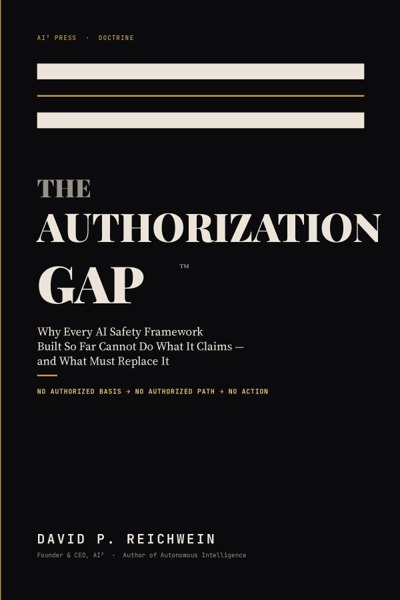
The Authorization Gap™
Why Every AI Safety Framework Built So Far Cannot Do What It Claims, and What Must Replace It.
- PART IThe Problem: the closed loop, five failure modes, and why the gap is already here
- PART IIThe Architecture: why hardware, the authorization protocol, and the complete stack
- PART IIIThe Three Gaps: execution, the constitutional question, the execution environment
- PART IVThe World at Stake: three diverging regimes and the Distillation War
- PART VThe Path Forward: Proof of Restraint and a deployment framework for boards
The Authorization Gap™ is not a reason to stop deploying AI. It is a reason to deploy it correctly.The Authorization Gap™, IntroductionGet it on Amazon
Where to go next
Where the exposure sits, what to ask before an agent goes live, and the deployment framework.
The book →A 21-page field guide: the four-fact case screen, the six-step failure map, discovery and certification. Expert witness services through [AI2].
The counsel guide →Expert witness →The formal papers: deterministic execution boundaries, state-space authorization and the full control theory.
ai2papers.com →ChronaGate™, the independent hardware authorization gate. First production units ship January 2027.
chronagate.com →Questions
What is the Authorization Gap™?
The structural void between an AI system's decision and that decision's execution. It is the distance between what an AI agent can do and what anyone actually authorized it to do at the moment it acted.
Does a kill switch close it?
No. A kill switch acts after the agent has started acting, so it can only measure how long the gap was open. The gap closes only when authorization is required before execution.
How is this different from access control?
Identity answers who is acting. Access policy answers what they may do. The Authorization Gap™ is about enforcement: whether anything outside the AI system has to say yes before the action actually runs. A correct policy that nothing enforces at the moment of execution leaves the gap open.
Why don't guardrails close it?
Most guardrails run inside the same system they are meant to control. They share its runtime, its credentials and its failure modes, so the cause that makes the agent act wrongly can disable the guardrail at the same moment.
Is this an argument against AI?
No. It is an argument for deploying AI with the same discipline every other safety-critical field already uses: let the system propose, and let an independent gate decide what executes.
Who defined it?
David P. Reichwein, a control-systems engineer with more than 40 years in nuclear, aerospace and heavy industry, including thousands of hours reviewing hazardous-location control systems for Factory Mutual. He is the founder of [AI2] (Asymmetric Intelligence & Innovation). davidreichwein.com